Answers covering open-source licensing, DeepSeek Harness plugin installation, pytrends migration, daily search volume math, and HTTP 429 handling.
Is this a truly free Google Trends scraper and open source?
Yes. google-trends-for-agent is a 100% free Google Trends scraper released under the MIT License on GitHub. Running the DeepSeek Harness plugin, CLI, or MCP server on your own machine costs nothing and requires no account.
How do I install the DeepSeek Harness (dsh) Google Trends plugin?
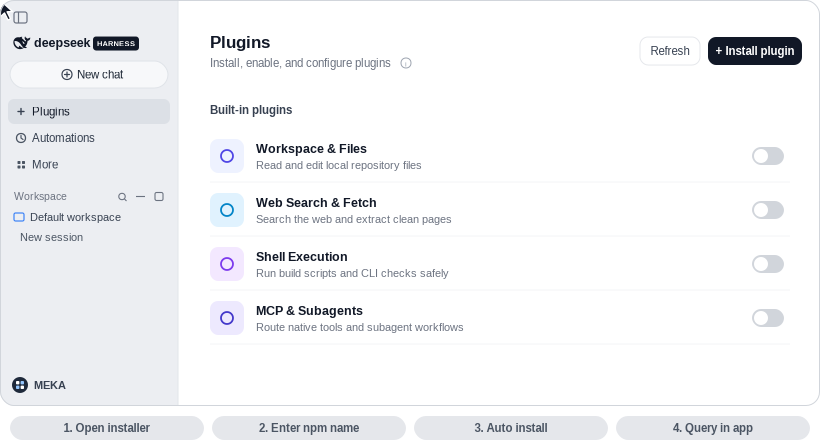
In DeepSeek Harness Desktop (macOS), open Plugins → + Install plugin, enter the npm package name google-trends-for-agent directly (without an npmjs.com URL), install with one click, and restart dsh. For dsh web CLI, run: dsh plugin --profile web add google-trends-for-agent.
How does the Google Trends scraper estimate daily search volume?
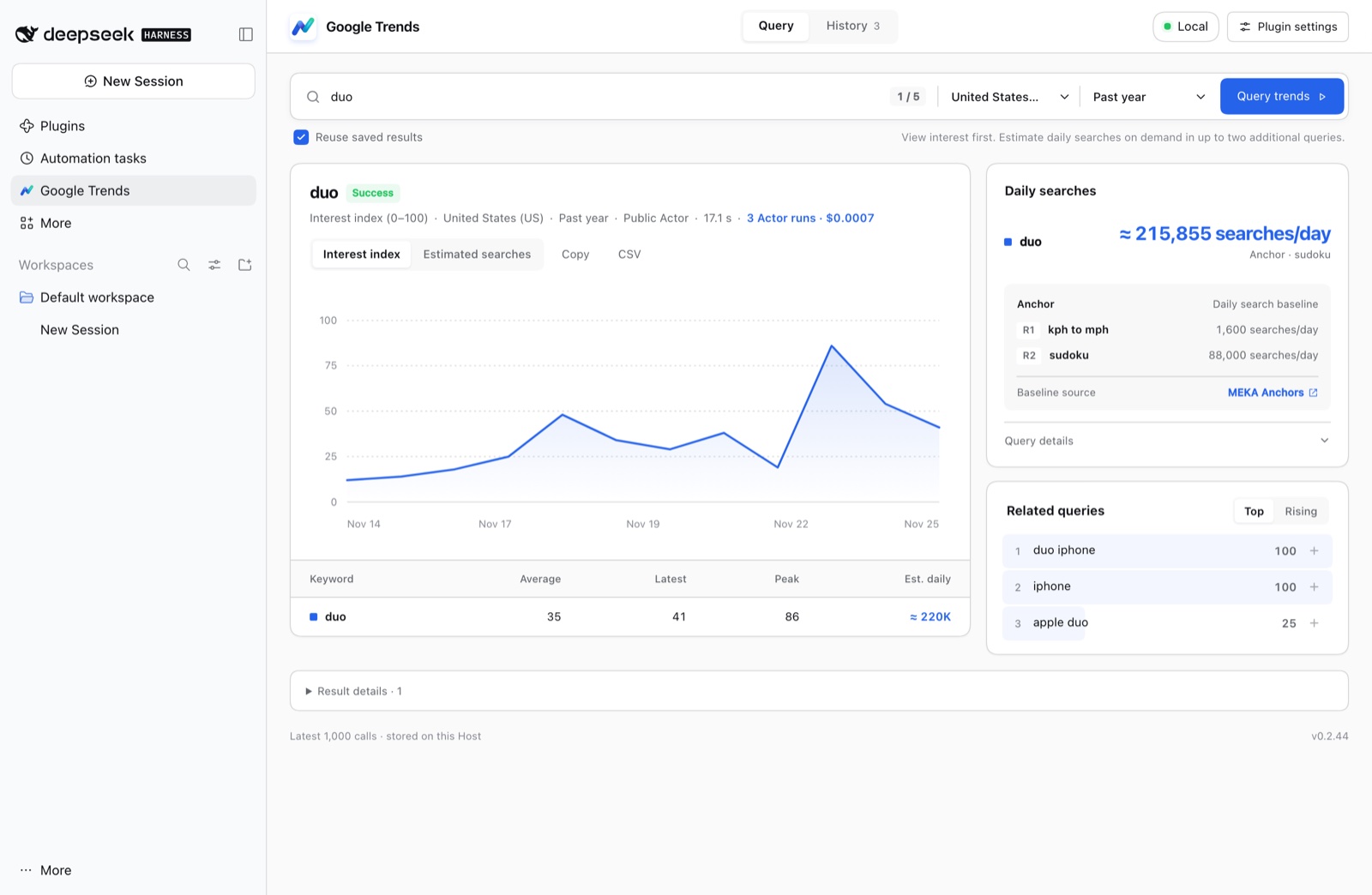
Google Trends returns relative 0–100 index values. This scraper pairs your target keywords with one of 59 verified regional Google Ads Keyword Planner anchors in the same time window, then multiplies (target mean / anchor mean) by the anchor's published dailySearches baseline.
Can this free Google Trends scraper replace pytrends after it was archived?
Yes. GeneralMills/pytrends was officially archived in April 2025 and frequently breaks on HTTP 429 while returning only 0–100 relative values. google-trends-for-agent is an actively maintained MIT open-source pytrends alternative for CLI, MCP, and AI agents with calibrated daily search volume, CSV/JSON export, and 1-click cloud Actor fallback.
How do I bypass HTTP 429 rate limits when scraping Google Trends?
Start free with your local IP. If Google Trends returns HTTP 429, switch in one click inside Plugin settings to the public open-source Apify Actor or deploy your own private Actor. Apify’s $5/month free tier ($0 idle cost) covers roughly 3,000–7,000 standard queries or 1,400–3,300 full volume-calibrated runs.
Which AI agents and coding assistants work with google-trends-for-agent?
Beyond the native DeepSeek Harness plugin (four tools plus the gtfa skill), it exposes a standard stdio MCP server (gtfa-mcp) for Claude Code, OpenAI Codex, Cursor, Windsurf, and OpenClaw, plus Apify's remote MCP gateway for hosted web agents.
How do I export CSV or download the 59 Google Trends calibration anchors?
In DeepSeek Harness or via the gtfa CLI (--csv / --json), every query exports clean CSV and JSON with cost ledgers. All 59 regional baseline anchors are also published openly as static JSON and JSON Schema directly on this page.
Does MEKA store my search keywords or Apify credentials?
Never. All queries route directly from your local machine or through your own Apify account credentials stored locally inside DeepSeek Harness or your CLI environment—with zero MEKA tracking servers in between.